

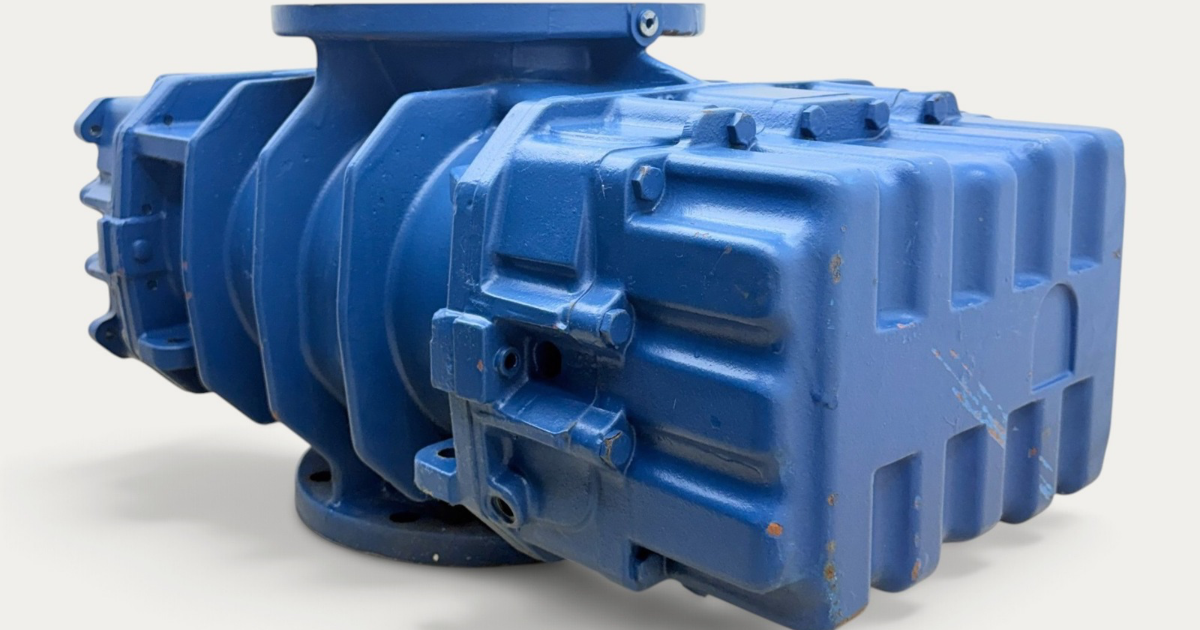
Industrial blowers fall into three core families: positive displacement (PD), centrifugal, and regenerative, and the right one depends on the pressure and flow your process actually demands, not just horsepower. PD blowers handle high-pressure, variable-flow duty like pneumatic conveying; centrifugal blowers deliver high-volume, moderate-pressure air for aeration and combustion; regenerative blowers cover low-pressure, oil-free duty like vacuum lifting and drying. Picking the wrong industrial blower type costs you efficiency, maintenance hours, or both.
We field this question weekly from plant managers who inherited a blower spec sheet with no context on why that model was chosen. This guide breaks down the three main blower types by pressure, flow, and duty cycle so you can match the machine to the job instead of guessing from a catalog.
What Are the Main Industrial Blower Types?
Every industrial blower moves air or gas by one of three mechanical principles: displacement (trapping and pushing a fixed volume per revolution), centrifugal force (accelerating air with an impeller and converting velocity to pressure), or regenerative staging (repeatedly accelerating air through impeller blades in a single housing). Each principle produces a distinct pressure/flow curve, and that curve, not the horsepower rating, is what determines whether a blower fits your process.
| Family | Typical Pressure Range | Typical Flow | Best Fit |
|---|---|---|---|
| Positive Displacement (PD) | High (up to 15+ psi) | Constant volume, varies with speed | Pneumatic conveying, wastewater aeration at depth, biogas |
| Centrifugal | Low-to-moderate (a few psi) | High volume | Combustion air, large aeration basins, drying |
| Regenerative | Low (typically under 2 psi) | Low-to-moderate, oil-free | Vacuum lifting, packaging, small aeration, dryers |
Positive Displacement (PD) Blowers: When You Need Pressure Regardless of Flow
For PD blowers, roots-type and rotary lobe designs are the most common. They trap a fixed volume of air between rotating lobes and the housing, then push it out against whatever downstream pressure exists. That means flow stays roughly proportional to shaft speed no matter what pressure the system throws back at it. This is exactly why PD blowers dominate pneumatic conveying, where line pressure changes as material loading changes, and why they show up in wastewater aeration basins with deeper diffuser placement that centrifugal units can't push against efficiently.
Trade-offs: PD blowers are louder, need more attention to lobe clearances and timing gears, and are less efficient at part-load than centrifugal machines. But if your process needs guaranteed flow at variable back-pressure, nothing else in the lineup does it as reliably.
- Good fit: pneumatic conveying of dry bulk solids, biogas/digester gas handling, deep aeration basins, applications with fluctuating system resistance.
- Watch for: pulsation at low speeds, oil-lubricated gearbox maintenance intervals, noise enclosure requirements.
Centrifugal Blowers: High Volume, Moderate Pressure
Centrifugal blowers use a rotating impeller to accelerate air, then convert that velocity into pressure through a diffuser or volute. They're the workhorse for large-volume, moderate-pressure jobs, think aeration basins at wastewater treatment plants, combustion air for boilers and furnaces, and general ventilation in process buildings. Multistage centrifugal units (and turbo blowers with high-speed, often magnetic-bearing designs) push higher pressure ranges while holding efficiency better than single-stage units.
The catch: centrifugal performance is sensitive to system back-pressure. Push a centrifugal blower against resistance it wasn't sized for and flow drops off fast; the opposite failure mode from a PD blower. That makes accurate system curve data non-negotiable at the sizing stage.
- Good fit: large aeration basins with stable diffuser depth, combustion air supply, cooling and drying processes needing high CFM.
- Watch for: surge at low flow on multistage units, bearing life at high speeds, sizing errors that leave you short on pressure margin.
Regenerative Blowers: Low Pressure, Oil-Free, Simple
Regenerative (also called side-channel or ring) blowers pass air through a series of impeller blades multiple times within a single stage, building pressure incrementally. They run oil-free by design, which makes them the default choice anywhere contamination is a concern such as vacuum lifting, pneumatic conveying of light material over short distances, packaging line vacuum, and small-scale aeration or fish farm systems. They're mechanically simple: no gears, no timing, fewer wear parts than PD or multistage centrifugal units.
The limitation is pressure ceiling. Regenerative blowers top out well below PD and often below centrifugal ranges, so they're not the answer for deep aeration or high-resistance conveying lines. Within their pressure window, though, they're typically the lowest-maintenance option on this list.
- Good fit: vacuum lifting/handling, small aeration systems, dryers, packaging and bagging lines, any oil-free requirement.
- Watch for: hard pressure ceiling, don't force a regenerative blower into a PD-duty application; noise at high speed.
How Do You Choose Between PD, Centrifugal, and Regenerative?
Start with the system curve, not the motor size. Answer these questions before shopping model numbers:
- What's the required pressure at the point of use? Under 2 psi and oil-free matters? Look at a regenerative blower. A few psi with high volume choose a centrifugal blower. Higher pressure, especially with variable back-pressure choose a PD blower.
- Does system resistance change during operation? Conveying lines with variable material loading favor PD's flat flow curve over centrifugal's pressure sensitivity.
- Is oil-free air a hard requirement? Regenerative blowers are inherently oil-free; PD units are typically oil-lubricated in the gearbox (though the airstream itself may or may not contact oil depending on design).
- What's the duty cycle and maintenance capacity? Continuous, unattended duty pushes you toward the family with the simplest wear-part profile for your pressure range, often regenerative below 2 psi, PD above it.
Aeration, Conveying, Vacuum Lifting: Matching Duty to Blower Family
Real-world processes tend to sort cleanly once you frame them by pressure and flow demand:
- Wastewater aeration (deep basins): PD blowers for the pressure needed to push air through diffusers at depth.
- Wastewater aeration (shallow/small basins): Centrifugal or regenerative, depending on basin depth and flow volume.
- Pneumatic conveying (dense phase, bulk solids): PD blowers for flow stability under variable line pressure.
- Pneumatic conveying (dilute phase, lightweight material, short runs): Regenerative blowers, oil-free and simpler to maintain.
- Combustion air / large ventilation: Centrifugal blowers for high CFM at low pressure rise.
- Vacuum lifting / pick-and-place: Regenerative blowers, near-universal choice for oil-free low-pressure vacuum.
- Drying and cooling processes: Centrifugal for high volume; regenerative for smaller, oil-free applications.
New, Rebuilt, or Pre-Owned: Sourcing the Right Blower for Your Budget and Timeline
Once you've settled on the family and duty point, sourcing comes down to lead time, budget, and how critical the application is to uptime. Warranty terms depend on the item and are listed on each product page and quote. New units bring the latest efficiency gains, but lead times can stretch on certain sizes. Blowers that have been restored to spec and tested carry lower cost with performance verified against original specifications which is a solid middle ground for planned replacements where you can schedule the swap. Pre-owned, inspected units are the fastest and most economical route when a line is down and you need a working blower matched to your pressure and flow point now, not in six weeks.
Whichever route fits your timeline, start by browsing current blower inventory. If you don't see the exact blower you need in stock, or you need help cross-referencing an existing model, request a quote and we'll match specs to your application.
What is the main difference between PD, centrifugal, and regenerative blowers?
PD blowers hold flow steady regardless of back-pressure and suit high-pressure or variable-resistance jobs like pneumatic conveying. Centrifugal blowers deliver high volume at low-to-moderate pressure but lose flow fast against added resistance. Regenerative blowers are oil-free, mechanically simple, and limited to low pressure, typically under 2 psi.
Which blower type is best for wastewater aeration?
It depends on basin depth: deep basins need the pressure a PD blower can hold against diffuser resistance, while shallow or smaller basins can run efficiently on centrifugal or regenerative units. Match the choice to actual diffuser depth and required air volume, not just tank size.
Are regenerative blowers oil-free?
Yes, regenerative blowers are inherently oil-free by design, which is why they're the default choice for vacuum lifting, packaging, and other contamination-sensitive applications. PD blowers typically use oil in the gearbox, so confirm airstream contact requirements if oil-free air is a hard spec.
Should I buy a new, rebuilt, or pre-owned industrial blower?
Warranty terms depend on the item and are listed on each product page and quote. New units offer current efficiency but can have longer lead times on certain sizes. Rebuilt blowers are restored to spec and tested, giving verified performance at lower cost for planned replacements, while pre-owned inspected units are the fastest option when a line is down and you need a matched duty point immediately.
How do I know if a blower fits my system's pressure and flow needs?
Start with your system curve — the pressure required at your actual flow rate — rather than sizing off horsepower or an existing model number. Compare that curve to the family that best holds performance in your pressure range, and confirm fit before ordering.


