

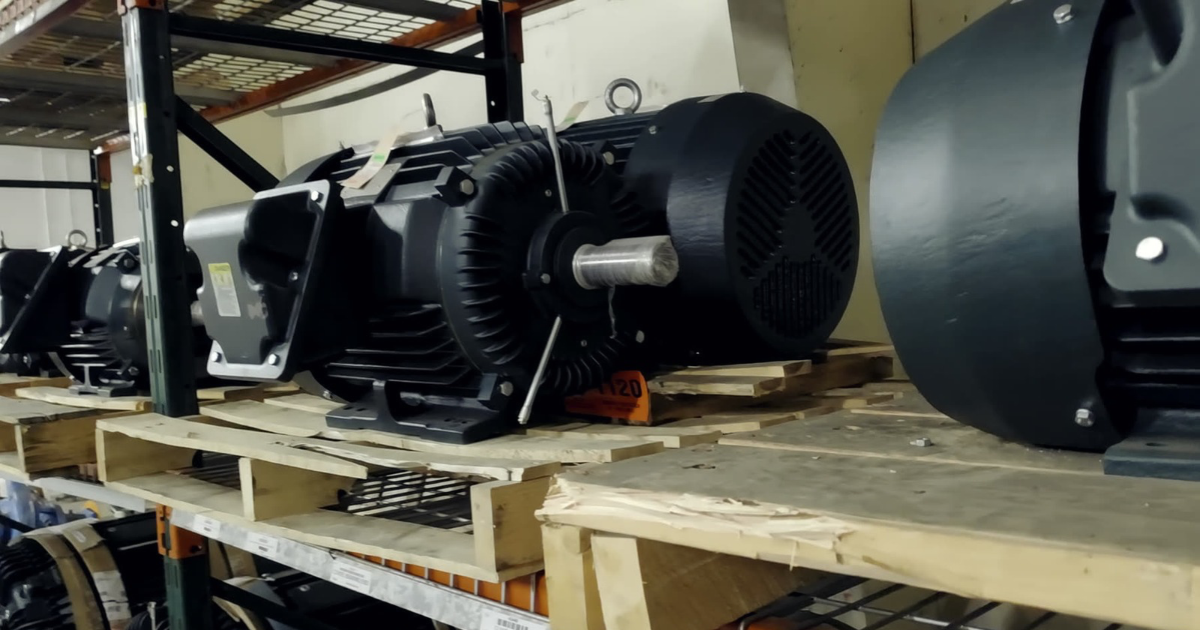
When the OEM discontinues your pump or that nameplate hasn't existed since a prior administration, obsolete equipment replacement comes down to four steps: capture every nameplate data point before the unit comes apart, cross-reference against current production models, decide between a true drop-in and an adapted installation, and pick a sourcing route that matches your timeline. Skip any one of those steps and you end up re-engineering a baseplate on a Saturday. This guide walks the whole playbook, pumps first since that's where we field the most "OEM discontinued my pump" calls, but the same logic applies to blowers, gearboxes, motors, and most rotating or static industrial equipment.
We handle discontinued equipment replacement weekly at DWP Industrial Sales. Plant managers call us with a cracked casing and a nameplate from a company that merged twice since it was installed. The process below is the same one our team runs on every call, written out so you can run it yourself before you dial.
Why Does Obsolete Equipment Replacement Keep Happening?
Pump and equipment lines get discontinued constantly, model consolidations after acquisitions, casting tooling retired, a series replaced by a "improved" one with different mounting dimensions. None of that is your fault, and none of it is a reason to replace the whole system when a cross-reference or an adapted unit will do. The equipment doesn't care who made it; it cares about flow, head, horsepower, and how it bolts to your piping and baseplate.
Step One: Capture the Nameplate Before Anything Moves
This is the step people skip because the unit is leaking, the shift is ending, or the nameplate is half corroded off. Do it anyway, before disassembly, before the rigger shows up. Once a pump is in pieces on a bench, half the data you need walks away with the old impeller and gasket material.
Photograph the nameplate dead-on, in focus, with flash if needed. Then record, in writing, everything legible:
- Manufacturer name and model/series number
- Serial number
- Pump size designation (e.g., 3x4-10)
- Impeller diameter, if stamped
- GPM / flow rate and TDH / head at duty point
- RPM
- Motor horsepower, frame size, voltage/phase
- Material of construction (cast iron, bronze fitted, stainless, etc.)
- Any casting numbers or part numbers on the volute or casing itself — these sometimes survive when the nameplate doesn't
If the nameplate is gone entirely, pull dimensional data instead: suction and discharge sizes, centerline height, bolt pattern and hole spacing on the baseplate, shaft diameter, and coupling type. A tape measure and a notepad will do more for your cross-reference than a guess at the brand.
Step Two: Cross-Reference Against Current Production
With nameplate and dimensional data in hand, the cross-reference is a matter of matching hydraulic performance first, then physical footprint. A legitimate cross-reference lines up:
| Criteria | Why it matters |
|---|---|
| Flow (GPM) and head (TDH) at duty point | Determines if the replacement actually does the job, not just resembles the old unit |
| Suction/discharge size and orientation | Drives piping fit without rework |
| Shaft/coupling type and motor frame | Determines if existing motor and coupling can be reused |
| Baseplate footprint and bolt pattern | Determines drop-in vs. adaptation |
| Materials of construction | Chemical compatibility with the process fluid |
This is also the point where many buyers discover the original brand doesn't matter nearly as much as they thought. A current-production pump from a different manufacturer, matched correctly on these five criteria, will run the application the same way the discontinued one did.
Drop-In vs. Adapted Replacement: How to Decide
Once you've got a candidate replacement, there's one real decision left: does it bolt straight in, or does it need adaptation?
Drop-in replacement means the new unit matches the old one's footprint, suction/discharge locations, shaft height, and coupling close enough that it installs on the existing baseplate and piping with no modification. This is the outcome everyone wants because it keeps downtime and labor cost to a minimum.
Adapted replacement means the hydraulics match but the physical footprint doesn't, different baseplate, different shaft height, different suction/discharge orientation. Adaptation can mean a new baseplate, spool pieces on the suction or discharge, a coupling guard modification, or in some cases pouring a new foundation pad. None of this is a dealbreaker; it's just a different scope and a different timeline, and it needs to be priced and scheduled as such rather than discovered mid-install.
The honest trade-off: a drop-in replacement can sometimes mean accepting a slightly different efficiency curve or a marginally different impeller trim to match the exact footprint. An adapted replacement can hit the duty point more precisely but costs more in labor and lead time. Neither answer is wrong, it depends on whether you're chasing uptime this week or optimizing for the next ten years of operating cost.
Sourcing Routes: New, Rebuilt, or Pre-Owned
Once drop-in vs. adapted is settled, the sourcing route determines how fast the unit shows up and what it costs.
- New production equivalents are the first call for most discontinued equipment replacement jobs, current manufacturers building equivalent hydraulics on current tooling, with full documentation and warranty. Lead times vary by brand and size, but this route gives you the cleanest paper trail going forward.
- Rebuilt units, restored to spec and tested, are a solid option when the exact original hydraulic match matters more than having a brand-new casting, useful when you need to keep an older piping configuration exactly as-is.
- Pre-owned, inspected equipment fills the gap when budget or lead time rules out new, and a rebuilt unit in the right spec isn't available. We inspect before it leaves the floor, but pre-owned is the last resort in the stack, not the first move.
When you're not sure which route fits or when the nameplate is too far gone to cross-reference with confidence, that's what an equipment sourcing service is for. We run the cross-reference, check current availability across new, rebuilt, and pre-owned channels, and come back with real options instead of a guess.
What to Do When the OEM Discontinued Your Pump Entirely
"OEM discontinued my pump" is the single most common opening line we hear, and it's rarely a dead end, it just means the search widens. Here's the order of operations:
- Confirm with the OEM (or its successor company, if it was acquired) whether a direct successor model exists.
- If not, pull your nameplate and dimensional data per Step One above.
- Cross-reference against current production from any manufacturer whose hydraulics and footprint match, brand loyalty doesn't keep a process running, correct specs do.
- If no clean cross-reference exists, evaluate adaptation (new baseplate, spool pieces) against the cost of a rebuilt unit sourced to original spec.
- If downtime is active and immediate, pre-owned inspected inventory can bridge the gap while a longer-term replacement is sourced.
This is exactly the sequence we run for walk-in and phone calls, and it's faster with a second set of eyes that's done it a thousand times.
Documentation to Keep Going Forward
Once you've replaced the obsolete unit, close the loop so this doesn't happen again in five years with a different tech standing in the same spot you were:
- Photograph the new nameplate and file it with the asset record
- Record the cross-reference logic, what you matched and why, not just the final model number
- Note whether it was a drop-in or adapted install, and keep drawings of any adaptation hardware
- Flag the replacement source (new, rebuilt, or pre-owned) in your CMMS so future sourcing starts from a known baseline
Getting It Done
Obsolete equipment replacement is a solvable problem every time, it just takes the right data captured in the right order and a sourcing partner who'll run the cross-reference instead of just quoting a part number. If you've got a nameplate, a photo, or even just a tape measure and a bolt pattern, start there. When you're ready to move, request a quote and we'll tell you straight whether it's a drop-in, what it'll take to adapt, and which sourcing route gets you running fastest.
What do I do first when I discover my pump is discontinued?
Photograph and record the nameplate data before any disassembly, manufacturer, model, GPM, head, RPM, and materials. That data drives every cross-reference decision that follows, and it's often lost once the unit comes apart.
Can I always get a drop-in replacement for an obsolete pump?
Not always. A drop-in works when the new unit's footprint, suction/discharge, and shaft height match the old baseplate and piping exactly; otherwise you're looking at an adapted install with a new baseplate or spool pieces, which is a different cost and timeline, not a failure.
Does it matter if the replacement pump is a different brand than the original?
No — matching flow, head, footprint, and materials of construction is what makes a replacement work, not the badge on the casing. Brand loyalty doesn't keep a process running; correct specs do.
Is a rebuilt pump as good as a new one for a discontinued model?
A unit restored to spec and tested can be the right call when you need to match an older hydraulic profile exactly, while new production typically offers the cleanest documentation and lead time going forward. The right choice depends on your piping configuration and timeline.
What if I can't identify the pump at all?
Pull dimensional data instead of nameplate data, suction/discharge size, centerline height, bolt pattern, and shaft diameter and a sourcing service can cross-reference from there even with no legible nameplate.


